

TLDR
SEO for coaches means showing up when your future clients search for the help you provide, not posting into the void and hoping the algorithm is kind. Search visitors are already shopping for a coach; social scrollers are browsing. This guide covers the searches that win coaching clients, how to get cited by AI search tools, the authority signals Google expects from coaches, and the technical basics. Do it yourself with the right method, or get one-to-one help.
On This Page
SEO for coaches starts from one fact: your future clients are already searching. Right now, someone is typing “executive coach for tech leaders” or “business coach for agency owners” into Google, and they are going to hire one of the coaches they find on page one.
This guide shows you how to be one of those coaches: which searches are worth chasing, how to build pages that rank for them, and how to turn that visibility into a pipeline that does not depend on daily posting.
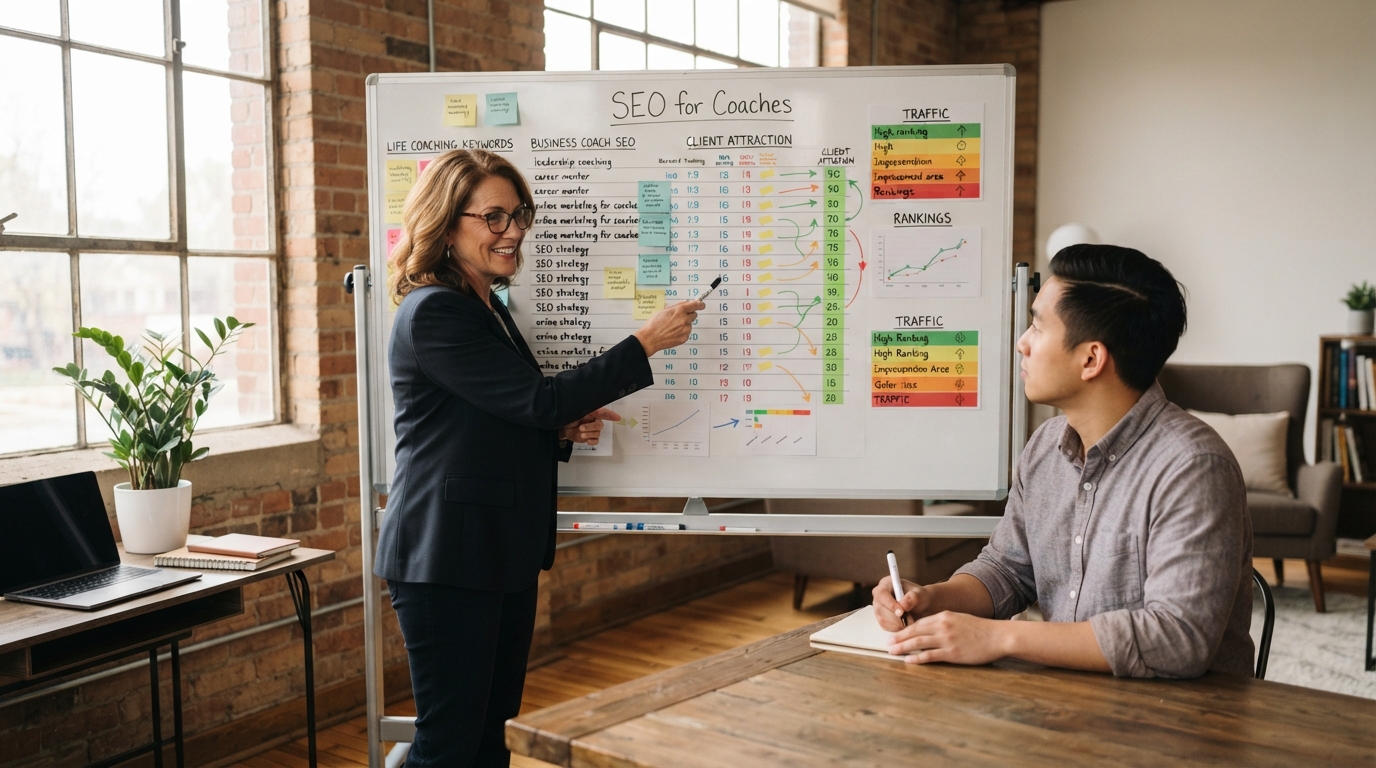
Why search beats the social treadmill for coaches
Most coaches market the same way: post on Instagram or LinkedIn every day and hope the right person sees it. The problem is shelf life. A social post is old within hours, so the work never compounds. You are renting attention, and the rent is due every morning.
A page that ranks works differently. You build it once and it keeps bringing in the people who searched for exactly what you do, this week, next month, next year. One good page can out-produce a year of posting, because it meets people at the moment they decided to look for help.
There is a second difference that matters even more: intent. Someone scrolling past your post is browsing. Someone who searched “burnout coach for executives” is shopping. Shoppers hire. This is why search traffic converts to discovery calls at a rate social traffic rarely touches, and why SEO for coaches is worth the patience it takes.
The searches that win coaching clients
The foundation of SEO for coaches is picking the right searches. Most coaches aim at broad terms like “life coach” or “business coach” and give up when nothing happens. Those terms are brutally competitive, and worse, they attract browsers: students, researchers, other coaches, people writing listicles. Lots of traffic, no clients.
High-intent searches: shopping, not browsing
The searches that pay are the specific ones a person types when they already know they want help:
- “executive leadership coach for female CEOs in tech”
- “holistic nutrition coach for postpartum recovery”
- “financial mindset coaching for millennial entrepreneurs”
- “business coach for agency owners”
Each of these has lower search volume than “life coach”. Each one is typed by someone who is much closer to hiring. Ten shoppers are worth more than a thousand browsers, and these searches are far easier to win because the big directories and marketplaces do not bother with them.
This holds across every coaching niche. SEO for business coaches runs on phrases like “business coach for SaaS founders”. SEO for life coaches runs on phrases like “life coach for career changers”. SEO for online coaches adds the delivery angle, because your market is everyone, not everyone near you. If you create courses as well as 1:1 work, the same logic covers SEO for coaches and course creators: “course creation coach for consultants” beats “coaching courses” every time.
How to find your phrases
Start with your clients, not a tool. List the problems your last ten clients brought you, in the words they used on the first call. Those phrases, attached to your title, are your candidates. Only then open a keyword tool to check volume and difficulty. The tool validates demand; it does not invent it. I keep a current list of the free tools that are actually enough for this on my best free keyword research tools page.
If you want the full method for separating the searches that sell from the searches that just look busy, read Buyers Not Browsers. It is the short version of everything I coach.
Getting found on AI search
Your future clients are not only typing into Google anymore. They ask ChatGPT and Google’s AI answers questions like “how do I find a good executive coach” and “do I need a business coach or a consultant”, and the tools answer with a shortlist of names and sources. Coaches who get cited in those answers skip the line.
Getting cited is not a separate discipline. It is the same work, done more clearly:
State what you do in one plain sentence near the top of your homepage and your about page. “I help burned-out executives rebuild their working lives” is citable. “I empower transformation journeys” is not.
Answer real questions directly. When a page on your site answers a specific question in the first sentence after the heading, AI tools can lift it. Vague, windy copy gives them nothing to quote.
Keep your language consistent. Same title, same niche phrase, same name everywhere your site mentions what you do. Consistency is how machines build confidence about who you are.
Show real evidence. Pages with specific numbers, named experience, and concrete examples give AI tools something solid to repeat. Thin, generic pages get skipped.
I wrote a practical playbook for this: how to get cited by ChatGPT. And if you want guided help on this piece specifically, it is part of my SEO coaching for AI search.

Authority signals that convince Google and clients
Coaching sits in the zone Google watches carefully, because your advice affects someone’s career, health, or money. Google looks for evidence that a real, qualified person stands behind the site. So do your future clients. The same signals serve both:
- An about page with real substance. Your story, your credentials, your certifications, your years in the work. Not a paragraph of adjectives.
- Proof of outcomes. Client results, with specifics. A named case study beats a page of testimonials. (Mine is public: how one consultant went from 20 to 74 leads a month through organic search.)
- Outside validation. When other sites mention or link to you, it counts as a vote. Guest posts, podcast appearances, and partnerships all earn these over time, and they bring referral clients while the rankings build.
None of this is decoration. It is what separates coaches who rank from coaches who blog into the void.
Content that compounds
Random blog posts do not build rankings; connected content does. The structure that works for coaches is one strong pillar page per core topic, supported by smaller posts that each answer one specific question, all linked together. The pillar shows Google the breadth; the posts show the depth; the internal links tie the expertise together.
For a burnout coach, the pillar might be “executive burnout coaching” and the posts answer the questions clients actually ask: what burnout coaching costs, how long it takes, how it differs from therapy, what the first session looks like. Every post is a door into the pillar, and the pillar is the page that sells.
Write one post a month if that is what you have. Twelve connected posts beat fifty scattered ones.
Technical basics
Technical SEO for coaches is mostly about not getting in your own way. Two things cover nearly all of it:
- Mobile. Most of your future clients will first meet your site on a phone, between meetings. If your pages pinch, zoom, or scroll sideways, they leave, and Google notices.
- Speed. Slow pages lose visitors and rankings. Compress images, keep plugins lean, and check your load time a few times a year. My guide to speeding up your pages covers the basics, and if you are on WordPress, here is the honest answer on whether you need an SEO plugin.
Everything beyond that is refinement. Get these two right and move on to the work that actually differentiates you.

Frequently asked questions about SEO for coaches
Do online coaches and consultants need SEO?
If your clients can find you without knowing your name, yes. Referrals and social both cap out at the size of your network. Search is the one channel where people who have never heard of you can arrive already looking for the help you sell. For coaches and consultants who work remotely, that is the whole market, not a slice of it.
How do coaches get found on AI search?
By being the clearest answer. Say plainly who you help and how, answer specific questions in the first sentence after a heading, keep your naming consistent across your site, and put real credentials and results on the page. AI tools cite sources they can understand and trust. The section above on AI search covers the working details.
How long does SEO take to work for a coaching business?
Expect 3 to 6 months before a new page earns real visibility, faster if your site already has some authority. It is slower than posting, but the output compounds: the page you publish this quarter keeps working next year. Social gives you hours per effort. Search gives you years.
Can I do my own SEO as a coach?
Yes, and many coaches should start that way. The core skills, picking the right searches and building pages that answer them, are learnable, and a structured workbook or a few months of coaching will take you most of the way. Done-for-you help makes sense later, when the opportunity cost of your time flips the math.
Is blogging still worth it in the age of AI?
Yes, if the posts are yours. Generic advice is free everywhere now, including from AI itself, so generic posts win nothing. Posts built on your client experience, your frameworks, and your specific niche still rank and still get cited, because they contain things only you can say.
Do I need SEO if I already get clients from social media?
Keep what works, but notice the trade: social income stops the week you stop posting. Search builds an asset you own. Most coaches I work with do not quit social; they just stop depending on it.

Where to go from here
You can do this yourself, or you can do it with help.
If you want the self-serve path, start with The SHOULD Framework workbook. It is the exact method I use to decide which searches are worth a page and which ones only look tempting, built for business owners who want the answer without the agency. It is $37.
If you want a guide, that is what I do. One-to-one SEO coaching means we work on your actual coaching site together: your searches, your pages, your pipeline. Read how the coaching works, or apply for SEO coaching and tell me about your practice.
Either way, stop renting attention. Your future clients are already searching. Be the coach they find.
